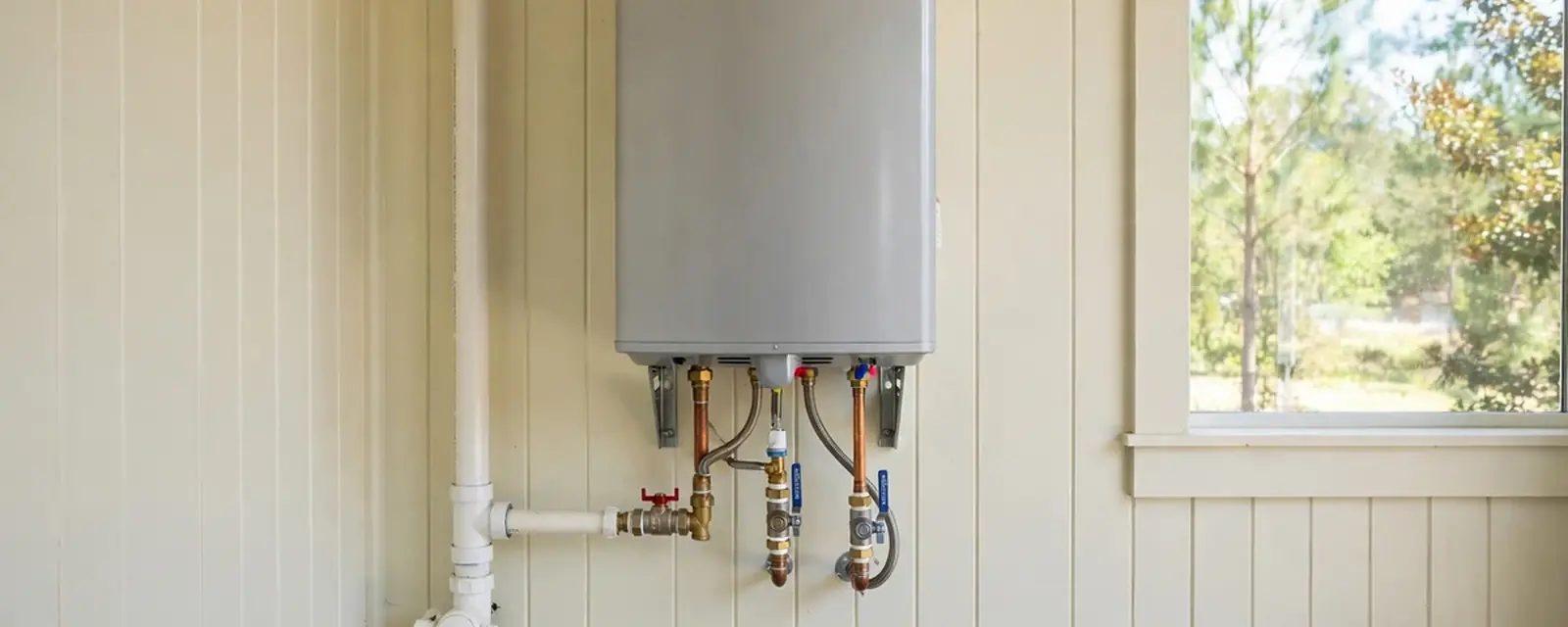
Why a tankless install is more than a swap
A tank heater needs a small gas line and a simple vent. A tankless unit burns much more gas at once, so the line often has to be larger. Its vent usually changes to a sealed pipe that exits through the wall or roof. It needs power for the control board and fan, and many high efficiency units need a drain for condensate.
Each of these steps is simple on its own. Together they are why the same family of heaters can be a half-day job in one home and a full day in another.
Gas line sizing
Gas capacity is the most common surprise. A line sized for a tank may not carry enough gas for a tankless unit at full firing. The installer measures the run from the meter and compares it to the unit's needs. If the line is too small, a larger one is run, which adds cost.
Ask for this check up front. It is better to learn about a gas line change before you buy the unit than after it is on the garage floor.
Venting and where the unit goes
Many tankless units are mounted on an exterior wall so the vent can exit directly. Interior locations need longer vent runs, with rules on length and clearances. Garages are common locations, and attics are possible but need access for service.
- Exterior wall mounting is the simplest vent path.
- Roof vents are longer and cost more.
- Clearances around the unit and the vent are set by the manufacturer.
- Access for yearly flushing matters.
Power and condensate drain
Tankless units plug into a standard outlet. If none is near, an outlet has to be added. High efficiency condensing models make acidic condensate that must drain to a proper location, sometimes through a neutralizer. That requires a nearby drain or a small pump.
Sizing the unit to your house
Tankless units are sized by flow rate and temperature rise. The incoming water in North Texas is colder in winter, so the unit must raise it further. Count the fixtures that run at once, and choose a unit that covers that demand with margin.
A single person in a small home needs less than a family with two bathrooms in use at the same time. If you add a recirculation loop, mention it, since it changes the setup.
| Household pattern | Typical need | Note |
|---|---|---|
| One or two people, one bath | Smaller unit | Check kitchen sink flow too |
| Family with two baths | Mid-size unit | Two showers at once is the test |
| Large home, many fixtures | Larger unit or two units | Ask about recirculation |
| Home with soaking tub | Check flow for fill time | Tub fills draw heavily |
Maintenance after installation
A yearly flush clears scale from the heat exchanger. Service valves make that easy and should be part of the install. Our tankless water heater page covers service in detail, and water heater installation compares it to a tank.
What a good tankless estimate lists
A good estimate names each part of the job so you can see what is included. It lists the unit and its flow rating, the gas line work, the vent material and run length, the electrical connection, the condensate drain, the service valves, the permit if one is needed and the removal of the old tank. If any of those are missing, ask whether they are covered or expected to be added later.
The estimate should also say what warranty applies to the unit and to the labor. Heat exchangers often carry a long warranty from the maker, but labor coverage comes from the installer. Both matter, and they are separate.
Retrofit problems we see in older homes
Older houses have a few recurring snags when a tank is replaced with a tankless unit. A shared gas line may feed the furnace, the stove and the heater, so adding a larger load can starve the others. An old water supply may have galvanized sections that restrict flow. A garage wall may face a fence or a neighbor's window that sits too close to the vent terminal.
None of these ends the project. Each one has a fix. They are the reason the visit before the install matters, and why we measure the gas run and the vent path before we order a unit.
Coppell notes for a tankless upgrade
The city's 2025 water quality report for Coppell lists an average total chlorine residual of 3.10 parts per million and does not give hardness. Test strips give you a reading, and hardness decides how often to flush. Ask the Coppell building department whether a permit applies to a gas appliance change.
Many Coppell homes have a garage or exterior wall that suits a wall mount. Neighbors in Carrollton and Lewisville have the same questions, and the gas line check applies equally in each.
Sources: according to the City of Coppell 2025 water quality report, chlorine residual is 3.10 parts per million and hardness is not listed. Gas and vent guidelines come from the unit maker.
Want a plumber to look at it?
Call (817) 601-6266. Our 24/7 line is answered by a Coppell dispatcher.
Questions Coppell homeowners ask
Maybe. The installer measures the line and checks its capacity. Many tankless units need a larger line.
Gas, venting and permits make this a poor DIY job. A licensed plumber handles the gas connection and vent.
Most need electric power, so they stop in an outage unless a battery backup is added.