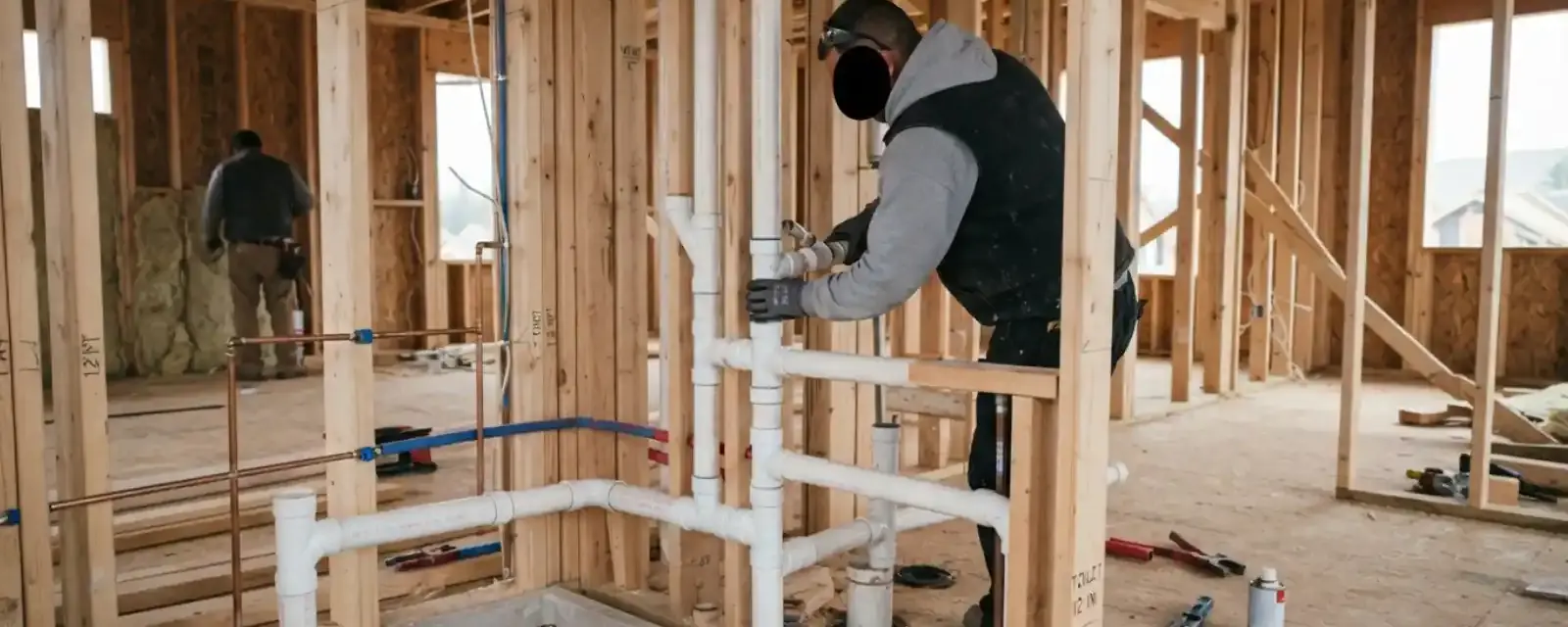
The supply side
Water enters through a service line from the meter, passes a main shutoff valve and splits into hot and cold lines. The cold line feeds each fixture. A branch goes to the water heater, which sends hot water out on a second set of lines. Shutoff valves at each fixture let you isolate a repair without turning off the whole house.
A pressure reducing valve on the main protects fixtures from high street pressure. An expansion tank takes up extra volume when water heats.
The drain side
Every fixture drains through a trap into a branch line. Branch lines meet a larger stack that falls to the house drain and then to the sewer. Drain pipe must slope downhill so waste flows. A cleanout gives access for clearing. If you are curious how these lines fail, see drain cleaning.
Vents
Vents are pipes that bring air into the drain so water flows freely and traps hold their seals. They connect near the fixture and run up through the roof. Without proper venting, drains gurgle and sewer gas can enter the house.
What each room needs
Each room has its own minimum set of connections.
| Room | Supply | Drain and vent |
|---|---|---|
| Kitchen | Hot and cold at sink, ice maker, dishwasher | Sink trap, dishwasher drain, disposal |
| Bathroom | Hot and cold at sink, tub or shower, toilet | Trap at each fixture, toilet flange, vent |
| Laundry | Hot and cold box | Standpipe and trap |
| Garage or utility | Water heater lines, hose bib | Floor drain if present |
| Outdoors | Hose bibs, irrigation connection | None, but needs a backflow device |
Order of work in a new or remodeled space
Skipping the pressure test before drywall is the most expensive shortcut.
- Plan fixture locations and rough-in dimensions.
- Run drain and vent pipes first, since they need slope.
- Run supply lines to each fixture.
- Test the system under pressure before closing walls.
- Schedule any required inspection.
- Install fixtures, then test again for leaks.
What homeowners can do and what needs a pro
For a remodel or new fixtures, our plumbing installation team can plan the job and give you a price first.
- Replace a faucet or showerhead on an existing supply.
- Swap a toilet fill valve or flapper.
- Clear a simple sink clog.
- Hire a licensed plumber for new lines, gas work, water heaters and anything inside walls.
Plan around the slab and the attic
In a slab-on-grade house, drain lines run in or under the concrete, and supply lines usually run through the attic and down the walls. That affects what is easy and what is not. Adding a sink on an exterior wall may be simple. Adding a bathroom in the middle of the house may mean cutting the slab to bring in a drain.
Before you commit to a layout, ask a plumber where the existing drain lines run. A camera or a set of original plans can show it. Moving a fixture a few feet can change the cost a lot.
Testing and inspection before you close the walls
The most important step in a remodel is the test. A pressure test on supply lines and a water test on drains show leaks while the walls are open. If your city requires an inspection, schedule it before drywall goes up. If it does not, we still test every job.
Keep records. A photo of the open walls with the pipes labeled is worth more than any later explanation, since it shows what is behind the paint for the next owner.
How plumbing and the rest of a remodel fit together
Plumbing work depends on other trades. The framer sets wall and floor locations, the electrician needs clearance from water lines and the drywall crew needs pipes tested before they close up. A plumber who can tell you in advance what has to happen first keeps the whole project on schedule.
If you are renovating a kitchen or bathroom, decide the fixture list early. Moving a sink or adding a second one changes the rough-in, and a late change after drywall is expensive. Choose your faucets and showers before the rough-in, because the valve bodies behind the wall must match the trim you pick. See plumbing installation for how we plan that work.
What Coppell homes need to know
Most Coppell houses were built after DFW Airport opened in 1974 and many sit on concrete slabs, so drain and supply lines may run in or under the foundation. The Dallas County Master Gardeners describe the regional clay soil as expansive, which can stress buried lines. Plan any slab work carefully.
Ask the Coppell building department about permits for plumbing work. You can check a plumber's license through the Texas State Board of Plumbing Examiners. If you also serve properties in Irving or Lewisville, remember each city has its own office.
Sources: build history is from published local history of Coppell, soil behavior is according to the Dallas County Master Gardeners, and permit questions go to the Coppell building department.
Want a plumber to look at it?
Call (817) 601-6266. Our 24/7 line is answered by a Coppell dispatcher.
Questions Coppell homeowners ask
Homeowners can do some work on their own home, but rules vary. Ask the Coppell building department what you can do and what needs a permit.
The main shutoff. Know where it is and test it once a year.
A test finds leaks while the pipes are still open and the repair is cheap.